
Reference Guide · Professional Pastry
The 10 basic creams in pastry making: from pastry cream to Chantilly cream
From pastry cream to whipped ganache, each type of cream has its own texture, uses, and technical requirements. This guide presents the ten main categories, then explains how to calculate ratios, storage, and the organization of a professional laboratory.
What is a cream in pastry making?
Pastry cream is a preparation whose structure depends on the combination of liquid ingredients and elements capable of thickening, emulsifying, or aerating it. The word "cream" thus encompasses several very different processes: cooking with starch, coagulating eggs, emulsifying with butter, or whipping dairy cream.
Pastry cream and Chantilly cream are not worked with the same tools. The former requires precise heating and regular stirring; the latter is primarily made cold, by incorporating air. Both, however, can be found in the same dessert.
To compare the major food families, we can look at their structural components: starch, egg proteins, fat, gelatin, or chocolate. Some preparations combine several mechanisms, which explains their consistency and shelf life limitations.
A distinction is also made between basic creams, prepared directly, and blended creams obtained by combining several bases. A diplomat cream is not simply a lighter pastry cream: the assembly, the incorporation temperature, and sometimes the gelling process alter its behavior.
- Cooked cream: temperature control is crucial.
- Whipped cream: the aeration and the cold control the texture.
- Blending cream: temperature compatibility prevents separation.
To delve deeper into the vocabulary and history of the preparations, consult our dedicated page on cream in pastry.
The 10 essential creams: a comparison chart
This table summarizes the main characteristics of ten preparations used in French pastry making. It is designed to guide the choice of texture and equipment, not to replace a validated recipe.
Shelf life is not specified here: it depends on the recipe, packaging and sanitary procedures of each laboratory.
| Cream | Base | Texture | Long-lasting | Conservation | Usage | Difficulty | Equipment |
|---|---|---|---|---|---|---|---|
| Custard | Starch + egg yolks | Firm, creamy | Good in the cold | To be validated according to PMS | Eclairs, mille-feuille, tarts | 1/3 | Pastocuiseur |
| Custard | Egg yolks | Fluid, coating | Low | To be validated according to PMS | Floating island, Bavarian cream, ice cream | 2/3 | Pastocuiseur |
| Chantilly cream | Dairy cream | Aerial, abundant | Fragile | To be validated according to PMS | Saint-Honoré, charlotte, plating | 2/3 | Mixer / Spreader |
| Buttercream | Butter | Dense, melting | Good according to recipe | To be validated according to PMS | Macarons, decorations, cakes | 2/3 | Drummer |
| Mousseline cream | Pastry cream + butter | Flexible and firm | Good in the cold | To be validated according to PMS | Strawberry cake, Paris-Brest | 2/3 | Pasta cooker + mixer |
| Diplomat cream | Pastry cream + whipped cream | Light, frothy | Average in the cold | To be validated according to PMS | Cream puffs, tarts, desserts | 3/3 | Pasta cooker + mixer |
| Chiboust cream | Pastry chef + meringue | Aerial, structured | Average in the cold | To be validated according to PMS | Saint-Honoré, dessert | 3/3 | Pasta cooker + mixer |
| Bavarian cream | English + gelatin | Foamy, melting | Good after taking | To be validated according to PMS | Desserts, verrines | 2/3 | Pasta cooker + mixer |
| Whipped ganache | Chocolate + cream | Foamy, chocolatey | Variable in cold | To be validated according to PMS | Cream puffs, desserts, poaching | 2/3 | Mixer + beater |
| Lemon cream | Eggs + butter | Smooth, tangy | Variable in cold | To be validated according to PMS | Lemon tart, dessert | 2/3 | Pastocuiseur |
- Base
- Starch + egg yolks
- Texture
- Firm, creamy
- Long-lasting
- Good in the cold
- Conservation
- According to PMS
- Uses
- Eclairs, mille-feuille, tarts
- Difficulty
- 1/3
- Home
- Pastocuiseur
- Base
- Egg yolks
- Texture
- Fluid, coating
- Long-lasting
- Low
- Conservation
- According to PMS
- Uses
- Floating island, Bavarian cream, ice cream
- Difficulty
- 2/3
- Home
- Pastocuiseur
- Base
- Dairy cream
- Texture
- Aerial, abundant
- Long-lasting
- Fragile
- Conservation
- According to PMS
- Uses
- Saint-Honoré, charlotte, plating
- Difficulty
- 2/3
- Home
- Mixer / Spreader
- Base
- Butter
- Texture
- Dense, melting
- Long-lasting
- Good according to recipe
- Conservation
- According to PMS
- Uses
- Macarons, decorations, cakes
- Difficulty
- 2/3
- Home
- Drummer
- Base
- Pastry cream + butter
- Texture
- Flexible and firm
- Long-lasting
- Good in the cold
- Conservation
- According to PMS
- Uses
- Strawberry cake, Paris-Brest
- Difficulty
- 2/3
- Home
- Pasta cooker + mixer
- Base
- Pastry cream + whipped cream
- Texture
- Light, frothy
- Long-lasting
- Average in the cold
- Conservation
- According to PMS
- Uses
- Cream puffs, tarts, desserts
- Difficulty
- 3/3
- Home
- Pasta cooker + mixer
- Base
- Pastry chef + meringue
- Texture
- Aerial, structured
- Long-lasting
- Average in the cold
- Conservation
- According to PMS
- Uses
- Saint-Honoré, dessert
- Difficulty
- 3/3
- Home
- Pasta cooker + mixer
- Base
- English + gelatin
- Texture
- Foamy, melting
- Long-lasting
- Good after taking
- Conservation
- According to PMS
- Uses
- Desserts, verrines
- Difficulty
- 2/3
- Home
- Pasta cooker + mixer
- Base
- Chocolate + cream
- Texture
- Foamy, chocolatey
- Long-lasting
- Variable in cold
- Conservation
- According to PMS
- Uses
- Cream puffs, desserts, poaching
- Difficulty
- 2/3
- Home
- Mixer + beater
- Base
- Eggs + butter
- Texture
- Smooth, tangy
- Long-lasting
- Variable in cold
- Conservation
- According to PMS
- Uses
- Lemon tart, dessert
- Difficulty
- 2/3
- Home
- Pastocuiseur
Difficulty ratings are editorial and indicative. Storage conditions do not constitute authorization for unrefrigerated storage.
Custard
Pastry cream is a cooked preparation in which milk, egg yolks, sugar, and starch combine to form a cream firm enough to fill an éclair or tart shell. Its firmness comes primarily from the gelatinization of the starch, supplemented by the egg proteins. Its texture should remain smooth, without any raw starch taste or lumps. For a laboratory setting, quality is judged after cooling as much as after cooking.
Common mistakes and checkpoints
Cooking too briefly leaves a mealy aftertaste; insufficient stirring promotes sedimentation at the bottom of the tank. Post-cooking contamination or improper cooling compromises product safety, even when the appearance is satisfactory. Therefore, the recipe, tank load, and cooling process must all be validated together.
Variants and applications
Pastry cream serves as the base for several preparations: mousseline cream is made with butter, diplomat cream with whipped cream and often gelatin. Cold pastry cream and the ready-made version, however, follow different formulation and usage principles.
Related processes are detailed separately: cold pastry cream et brick pastry cream.
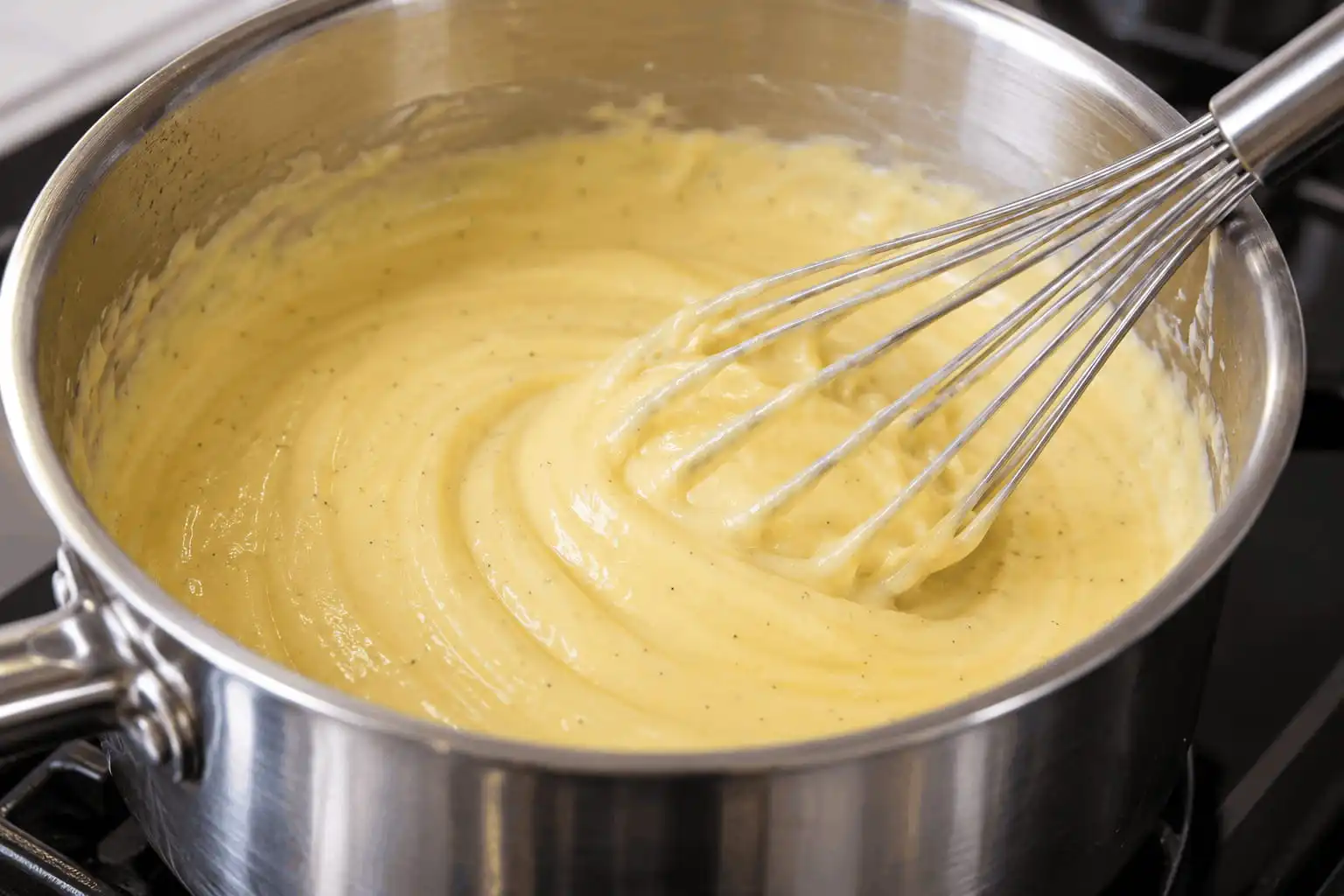
Custard
Crème anglaise is a cooked emulsion of milk or cream, egg yolks, and sugar. Unlike pastry cream, it doesn't rely on starch thickening: the proteins in the yolks gradually thicken the mixture. Its ideal texture coats a spatula without becoming flaky. It's used as a dessert sauce, the base for Bavarian cream, and the base for some frozen desserts.
Common mistakes and checkpoints
The main risk is excessive coagulation of the egg yolks, which causes graininess and phase separation. The temperature increase must be gradual, stirring continuous, and the temperature measured on the product. The coating temperature range commonly indicated in pastry making is around 82 to 85°C; this must be adjusted according to the composition and the validated process.
Variants and applications
Custard differs from pastry cream in its fluidity and lack of starch. For batch production, pay particular attention to the accuracy of the probe, the temperature distribution, and the reproducibility of the cooling process.
An article dedicated to custard will be added to this guide once its page has been created.
Chantilly cream
Chantilly cream is a sweetened whipped cream, sometimes flavored, whose lightness comes from the air incorporated and stabilized by the milk fat. The fat content and working temperature greatly influence its whipping ability. Properly prepared Chantilly cream should form a smooth, clean texture, without any graininess or oily appearance.
Common mistakes and checkpoints
Cream that isn't cold enough will whip up poorly; cream that's over-whipped will start to turn into butter. The amount of sugar should be appropriate for the intended use: a subtle garnish, a decorative element, or a plated dessert. The utensils, bowl, and cream must be kept in conditions that comply with the food safety plan.
Variants and applications
Whipped cream generally refers to cream that has been whipped by incorporating air. Chantilly cream is a sweetened version, traditionally flavored with vanilla. This distinction avoids confusion when writing technical specifications in the laboratory.
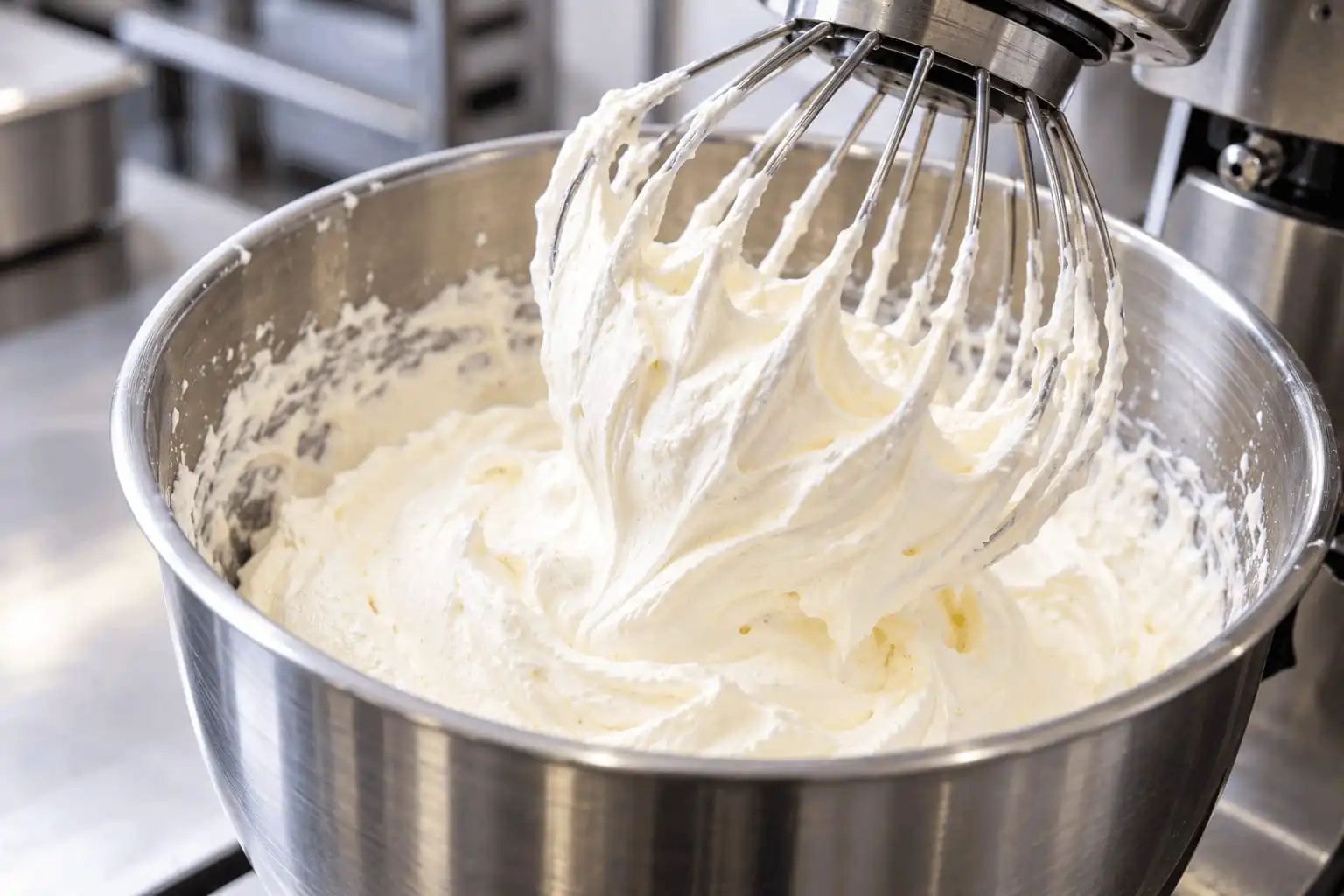
Buttercream
Buttercream combines a softened fat with a sweet base, which can take many forms depending on the pastry tradition. Some methods use a syrup and eggs, others a custard or pastry cream. The preparation remains highly suitable for piping and decorating, but its balance depends on the temperature of each component.
Common mistakes and checkpoints
A base that is too cold, excessively hard butter, or a poorly formed emulsion results in a grainy texture. Conversely, too much heat makes the cream soft and difficult to pipe. It's essential to consider the temperature of the ingredients, the order in which they are added, and the whipping time rather than the maximum speed.
Variants and applications
The choice of method depends on the desired taste, the required consistency, and how the cream will be stored and then brought back to working temperature.
Mousseline cream
Mousseline is a pastry cream enriched with butter and whipped to achieve a lighter texture than classic buttercream, while still maintaining its firmness. It's a standard filling for fraisier cakes and some versions of Paris-Brest. Its consistency depends on the original pastry recipe and how the butter is incorporated.
Common mistakes and checkpoints
If the two mixtures are at too different a temperature, the cream will curdle or reveal grains of butter. A pastry cream that hasn't been properly chilled also makes assembly tricky. The pastry chef therefore carefully monitors the tempering, the homogeneity of the base, and the degree of whipping.
Variants and applications
Mousseline meets a need for structure and richness; it should not be confused with diplomat cream, which is more mousse-like and less rich in butter.
Diplomat cream
Diplomat cream is a pastry cream lightened by the incorporation of whipped cream. Depending on the recipe, a small amount of gelatin helps the filling set. It combines the flavor and texture of a traditional pastry cream with a lighter, airier feel. It is often used to fill cream puffs and fruit tarts.
Common mistakes and checkpoints
A common mistake is to fold whipped cream into a base that is still too hot: the whipping will deflate and the texture will become uneven. Gelatin that is not properly hydrated or dispersed can form stringy bits. The mixture should be combined with two mixtures at compatible temperatures.
Variants and applications
Compared to mousseline, diplomate prioritizes lightness and abundance rather than richness in butter.
Chiboust cream
Chiboust, also known as Saint-Honoré cream, combines pastry cream and meringue, a traditional Italian dessert. The meringue provides volume and a light, airy texture; depending on the recipe, gelatin helps it set. This preparation requires precise planning, as the result is sensitive to the mixing temperatures and the resting time before use.
Common mistakes and checkpoints
An insufficiently stable meringue or over-mixing can cause the mousse to lose some of its volume. Assembling the mousse on a pastry base that is too cold can lead to clumps, while a base that is too warm will destabilize it. The steps must be repeatable and carried out without unnecessary interruption.
Variants and applications
The chiboust is particularly suitable when you want an airy garnish while retaining sufficient structure for plating.
Bavarian cream
Bavarian cream is typically made by adding gelatin to a custard base, then whipped cream. It is poured into a ring mold, a mold, or a glass before being chilled. Its texture combines a smooth, light consistency with a clean, crisp cut.
Common mistakes and checkpoints
Poor dispersion of the gelling agent creates areas that are too firm and others that are too soft. A very hot custard will cause the whipped cream to deflate. Conversely, a base that has cooled too much will begin to set before it is poured; therefore, the assembly must be synchronized.
Variants and applications
The choice of gelling agent dosage takes into account the final dessert, its weight, its method of unmolding and the presentation time.
Whipped ganache
Whipped ganache combines an emulsion of chocolate and cream, chilled before being whipped. It offers an intense aroma and a pouring texture that a runny ganache lacks. The chocolate-to-cream ratio depends on the type of chocolate, its composition, and the desired consistency.
Common mistakes and checkpoints
A poorly prepared initial emulsion can cause graininess; insufficient resting prevents the structure from forming correctly. Over-aeration creates a compact or brittle texture. The preparation is best organized in two stages: emulsification and resting, then assembly and plating.
Variants and applications
Gelatin is not always used: some recipes use it, others do not. It would be inaccurate to consider it a mandatory ingredient in all whipped ganache.
Lemon cream
Lemon curd combines citrus juice, eggs, sugar, and fat to create a tangy and smooth spread. Depending on the method, the butter is incorporated either while the mixture is still hot or after a controlled cooling phase. It should have a distinct acidity, without excessive bitterness or a cooked egg flavor.
Common mistakes and checkpoints
Overcooking results in coagulated egg particles; improperly peeled zest can impart bitterness. If the butter is not properly emulsified, the cream will separate upon cooling. Stirring, temperature control, and the quality of the raw materials determine the outcome.
Variants and applications
This preparation demonstrates the full benefit of a tank that heats regularly while allowing mixing and a controlled temperature decrease.
Laboratory methods
Creams in professional pastry making: ratios, yields and storage
Laboratory ratios are not just used to reproduce a taste. They allow for the sizing of purchases, the monitoring of losses, the organization of production cycles and the maintenance of consistency between teams.
The basic ratios you need to know
The calculation basis must be clearly defined: for a pastry chef, sugar, egg yolks, and starch can be expressed as a percentage of the reference milk mass. However, the unit of measurement for whipped ganache or buttercream is not the same as that for a primarily dairy-based preparation.
The following table lists the components whose proportions must be defined in a validated recipe sheet. The exact dosages must be confirmed by testing and recorded by the workshop.
| Prepare in advance | Basis of reference | Points to measure | Critical parameter |
|---|---|---|---|
| Pastry chef | Milk mass | Egg yolks, sugar, starch | Cooking and cooling |
| English | Mass of milk or cream | Egg yolks, sugar | Water table / coagulation |
| Whipped Cream | Mass of cream | Sugar, overflow | Product temperature |
| Muslin | Pastry dough | Butter added | Temperature of masses |
| Diplomat | Pastry dough | Whipped cream, gelling agent | Assembly |
| Chibout | Pastry dough | Meringue, optional gelling agent | Meringue stability |
| Bavarian | Custard mass | Gelling agent, whipped cream | Setting and pouring |
| Whipped ganache | Mass of cream | Chocolate, possibly a gelling agent | Crystallization |
| Lemon cream | Mass of juice | Eggs, sugar, butter | Cooking / emulsification |
Returns and losses
One liter of milk does not necessarily produce one liter of finished cream. Egg yolks, sugar, or butter increase the mass, while evaporation and transfers reduce the yield actually packaged.
To track this result, weigh the raw materials used and the product actually recovered after cooking, draining, and packaging. The difference indicates the losses related to the recipe, sticking in the tank, and the transfer operations.
The useful yield is also considered in terms of portions: a preparation may be profitable per kilogram produced, but impractical if the plating or cleaning operations become too long.
- Record the committed mass and the conditioned net mass.
- Record the duration of the complete cycle, including cleaning.
- Compare several cycles of the same recipe before setting a yield target.
Conservation and HACCP
The shelf life of a cream is not a universal value. It depends in particular on the composition, the heat treatment, the risk of recontamination after cooking, the packaging and the storage temperature.
Preparations containing eggs, dairy products, or a whipped phase require special attention. The professional must define shelf life periods adapted to their hazard analysis and procedures, with labeling and traceability compatible with the activity.
Regulation (EC) No 852/2004 lays down the general principles of hygiene and temperature control. The detailed requirements of the decree of 21 December 2009 concern, in particular, certain retail activities and institutional catering: its values should not be applied to every artisanal pastry shop without verification.
Organizing your production
Cooked creams can often be prepared before assembly, provided the appropriate cooling system is available and the approved shelf life is respected. Whipped creams, being more delicate, are generally best prepared close to the time of plating.
The planning must include the volumes per recipe, the actual usable capacity of the tank, waiting times, and cleaning between products. The same equipment cannot be reserved for multiple production runs simultaneously.
In a mixed activity of pastry and artisanal ice-cream parlor, the coordination of heating and cooling operations becomes particularly important.
To size a workshop or compare a recipe to the capacity of a pasta cooker, you can contact us.
Hubert Cloix's expertise
What equipment is needed to prepare creams in pastry making?
The equipment must be chosen according to the cream-making process and the volume to be produced. A preparation based on starch requires careful management of heating, stirring, and cooling; Chantilly cream primarily requires a cold-whipping tool.
Pasta cookers
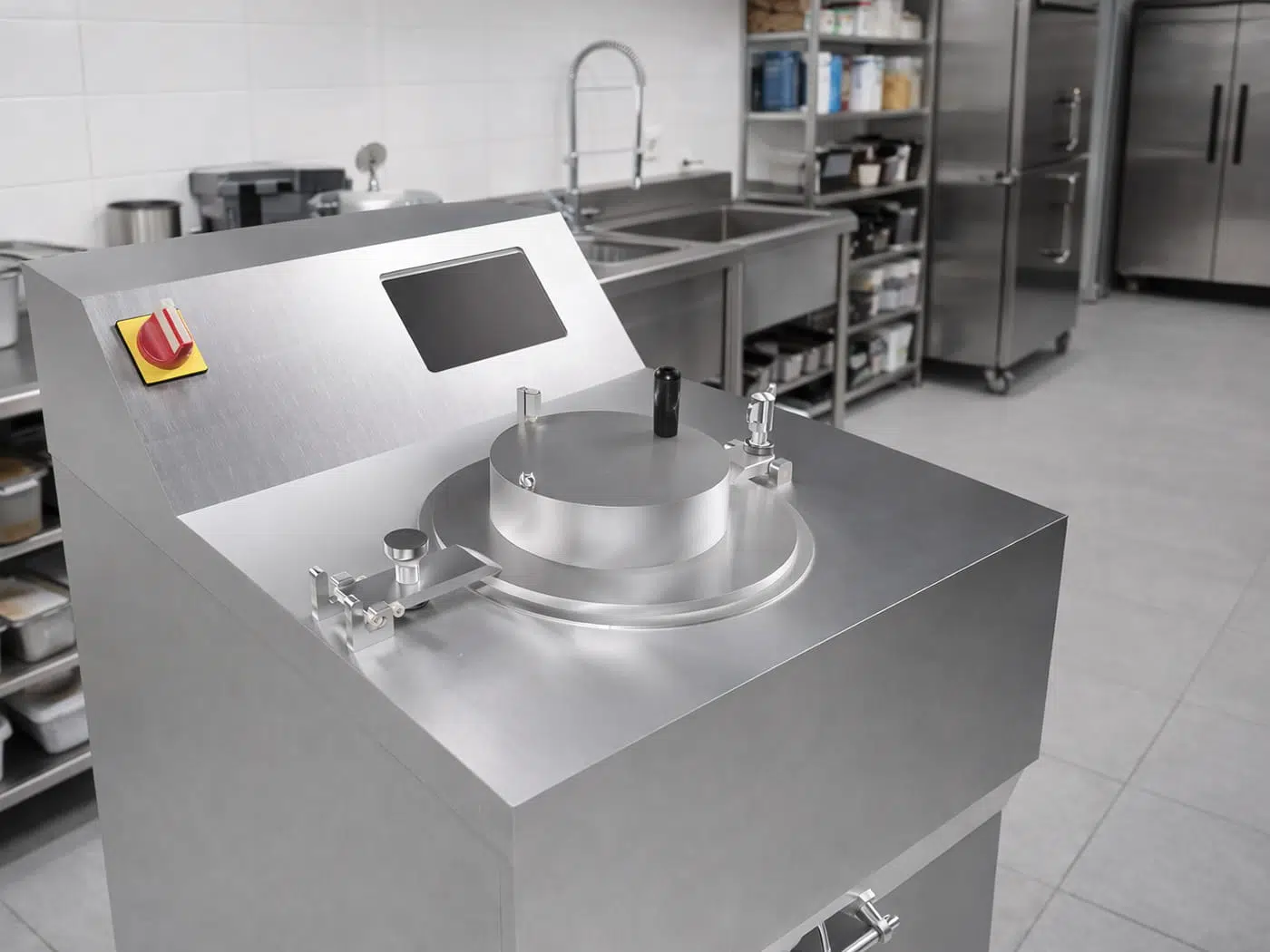
Hubert Cloix pasta cookers combine cooking, stirring, and cooling in a single machine. Their advantage is that they reproduce a defined cycle and limit manual handling between phases, provided the recipe is correctly configured.
The tanks in the range Custard Cooker They are available in several capacities, from 7 to 240 liters depending on the model offered by the manufacturer. For preparations sensitive to sticking, the design of the mixing and scraping mechanisms deserves as much attention as the heating power.
The page dedicated to the pastry cream machine allows for a detailed description of equipment criteria without turning this cream guide into a sales catalogue.
Chantilly and whipped cream machines
Whipped cream requires consistent whipping and precise temperature control. Depending on the volume, this can be done with a mixer or dedicated equipment, provided it is compatible with the recipe.
Cold and rapid cooling
Cooking alone does not guarantee the proper preservation of cream. Cooling and protection against contamination after cooking are essential, as is defining target temperatures through the food safety management plan.
La range of pasteurizers illustrates the thermal processes dedicated to ice cream making; however, an ice cream pasteurizer is not interchangeable with a pastocooker adapted for thick pastry cream.
Which machine for which cream?
| Family | Equipment | Priority criterion |
|---|---|---|
| Pastry chef, English, lemon | Pastocuiseur | Heating, stirring, cooling |
| Chantilly cream, whipped ganache | Mixer or bulking equipment | Ventilation and temperature |
| Diplomat, muslin, chiboust | Pasta cooker + mixer | Assembly organization |
| Frozen preparations | Pasteurizer + turbine as per application | Process and volume per cycle |
The ice cream makers They concern the churning of frozen preparations, not the whipping of Chantilly cream. For the entire process, the guide to making ice cream explains the technical basics.
Hubert Cloix has been designing and manufacturing its cooking and ice-making equipment in France since 1973, and is part of La French Fab.
La French made And the proximity of the design office allows us to study the specific constraints of our clients. Pasteurizer vs. Pasteurizer Comparison helps to distinguish the processes.
Additional ice cream equipment can be found in the category ice cream equipment, without confusion with machines manufactured in-house.
Frequently asked questions about pastry creams
Here are the answers to the most frequently asked technical questions, with a clear distinction between culinary uses and professional preservation requirements.
What are the 10 basic creams in pastry making?
Our selection includes pastry cream, crème anglaise, Chantilly cream, buttercream, mousseline cream, diplomat cream, chiboust cream, Bavarian cream, whipped ganache, and lemon cream. Other classifications are possible; this list focuses on preparations commonly used by pastry chefs. The guide's table compares their textures, uses, and standard equipment.
What is the difference between pastry cream and custard?
Pastry cream typically contains starch, which helps it set and gives it the structure needed for filling. Custard, on the other hand, is thickened primarily with egg yolks; it remains more fluid and spreadable. Both require precise cooking times, but they are not interchangeable in a recipe without adjustments.
What is the difference between Chantilly cream and whipped cream?
Whipped cream is dairy cream that has been whipped by incorporating air. Chantilly cream is a sweetened version, often flavored with vanilla. Both depend on the quality of the cream, its fat content, the working temperature, and the desired level of whipping.
How long does pastry cream keep?
There is no universal shelf life applicable to all pastry creams. Storage depends on the formulation, the heating process, the cooling rate, the packaging, and the risk of recontamination. A professional laboratory must define and justify the shelf life in its food safety management plan, and then monitor the corresponding temperature and labeling.
Can you freeze pastry creams?
Some preparations can withstand freezing, while others lose their structure after thawing. Creams thickened with starch may exhibit syneresis, meaning the release of water, and mousses may lose their aeration. Freezing, thawing, and re-use tests should be carried out on the actual recipe before making this a standard practice.
Why is my pastry cream curdling?
The texture can be altered by improper cooking, unsuitable stirring, or a destabilized emulsion during subsequent steps. Particles of coagulated egg, starch lumps, or separation of a fat phase can produce various visual defects. Diagnosis relies on observing the formula and the actual process, rather than identifying a single cause.
What is the difference between mousseline cream and diplomat cream?
Mousseline cream combines pastry cream with butter, giving it richness, a smooth texture, and structure. Diplomat cream combines pastry cream with whipped cream, often with a gelling agent, to achieve a lighter, mousse-like consistency. The choice depends on the final dessert, its desired consistency, and how it will be stored.
What equipment is needed to produce creams in large quantities?
The answer depends on the type of cream being made: a pastocooker for cooked preparations, a mixer or whipper for whipped creams, and cooling adapted to the production process. Custard Cooker It can combine several steps of certain recipes. Equipment must be sized according to net volumes, cycles, and cleaning requirements.
Which machine is best for making pastry cream in a professional pastry shop?
A machine must ensure consistent heating, mixing adapted to the viscosity, and cooling compatible with the laboratory's sanitary requirements. Usable capacity and scraping mechanisms are among the important criteria. Our page dedicated to the pastry cream machine details these needs and the technical solutions.
Are professional ratios different from family recipes?
The ingredients don't necessarily change, but the calculation method becomes more rigorous. The professional reasons in terms of mass, percentages relative to a defined base, net yield, and reproducibility between cycles. Each formula must be tested on actual equipment and then documented for use by multiple people in the laboratory.
Sources and method
The descriptions of texture and manufacturing are presented as technical principles. The tables do not constitute a validated recipe sheet or a universal health instruction.
- Regulation (EC) No 852/2004 of the European Parliament and of the Council — Food hygiene, April 29, 2004.
- Order of the 21 December 2009 — health rules applicable to certain retail and catering activities; scope to be verified.
- Professional Pasta Cooker — Hubert Cloix, characteristics of the range and cooking/cooling processes.