
Glacier Universe · Production · Equipment
The world of ice cream: machines and equipment for professionals
The world of ice cream making encompasses all the equipment needed to transform a mix into ice cream ready for storage, serving, or packaging. Depending on your business, your setup might be based on batch production, a continuous freezer, a compact solution for the food service industry, or an alternative to traditional ice cream.
What is the world of professional ice cream?
Professional ice cream production goes far beyond the ice cream maker. It begins with mix preparation, may include pasteurization and maturation, and continues with churning, freezing, storage, packaging, and finally, presentation to the customer. The right equipment therefore depends as much on the product being made as on how your production facility is organized.
Hubert Cloix has been designing and manufacturing ice cream machines in France since 1973. Their product lines cover tanks from 7 to 240 liters and are aimed at artisans, pastry chefs, restaurateurs, and production facilities seeking a streamlined process for preparation and production. Our workshop in Lognes and our industrial approach are presented on the dedicated page. French manufacturer of ice machines since 1973.
Four main areas can be used to structure a project: batch ice cream, continuous ice cream production, production for the hospitality industry (hotels, restaurants, and cafes), and alternatives to ice cream. The production volume, the number of product lines, the available space, and the service frequency then guide the choice between these different approaches.
The 4 ice production universes
There is no single way to produce professional ice cream. Each sector operates according to a different logic of volume, pace, and service; the purpose of this page is to help you quickly identify the method that best suits your project.
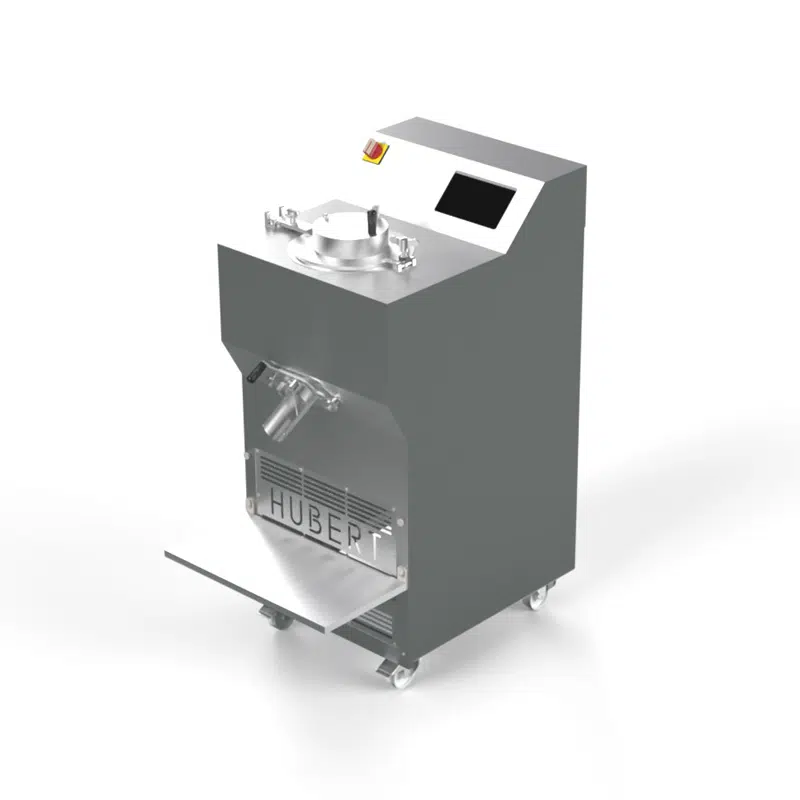
Batch ice cream (conventional machine)
Batch production operates in cycles: a defined quantity of mix is introduced, churned, and then extracted before the next cycle. This system is well-suited to artisanal ice cream makers, pastry chefs, and laboratories that work with several flavors or different batches throughout the day.
This approach facilitates recipe change and batch control.

Continuous ice (freezer)
The continuous freezer transforms the mix without operating in successive batches. It is integrated into an organization where throughput, regular machine feeding, and the sequence with filling or packaging steps become central.
This approach applies to workshops that wish to increase their production rate or structure a more automated line.
Ice cream in catering
A restaurant, hotel, or caterer generally doesn't have the same constraints as an ice cream shop. Quantities per flavor are smaller, available space is limited, and production must be integrated into the daily work of the kitchen or dessert preparation area.
The goal is to prioritize a compact and easy-to-integrate solution, without oversizing the equipment.
Alternatives to ice cream
The range of frozen treats can extend beyond the traditional tub: Italian ice cream, plant-based preparations, instant desserts, or concepts designed for different serving methods cater to a variety of needs. The choice of machine then depends more on the final product and its distribution method than on a classic artisanal ice cream shop model.
This approach can complement an existing activity or constitute a standalone offering.
| Universe | Principle | Profile | Key equipment |
|---|---|---|---|
| Batch | Production by successive cycles | Ice cream maker, pastry chef, artisanal laboratory | Ice turbine |
| Continued | Continuously fed production | High-speed workshop | Freezer continuous |
| Catering (Hotels, Restaurants, and Cafés) | Small batches integrated into the service | Restaurant, hotel, caterer | Compact turbine or dedicated solution |
| alternatives | Other product or other mode of service | Specialized concept or diversification | Machine adapted to the final product |
Which ice machine for which project?
Choosing a machine starts with your actual production. The number of liters per cycle is only one indicator: also consider the flavors, recipe changes, and production rate.
By production volume
For artisanal or diversified production, a turbine allows for batch processing and easy flavor changes. When production increases, the number of cycles and daily schedule must be considered before choosing the tank size. The dedicated page on professional ice cream machines made in France then allows for a comparison of available capacities.
By profession
An ice cream maker builds their workshop around ice cream production; a pastry chef often adds ice cream to an existing business; a restaurateur favors small quantities and compact equipment. The right machine therefore depends on the role of ice cream in your revenue, the frequency of production, and its place within your organization.
By additional equipment
A turbine or freezer doesn't operate in isolation in every project. Pasteurizers, ripeners, blast freezers, homogenizers, dosing machines, or display cases can complement the line depending on the recipe, storage method, and sales method. For a broader perspective, consult the professional ice cream equipment Available per family.


Are you a consultant, trainer, or subject matter expert? Discover the Hubert Cloix Ambassadors CircleAre you a reseller? Contact our team.
Making your own ice cream: methods, recipes and profitability
A suitable machine isn't enough: the consistency of ice cream also depends on the recipe, the process, and how you control the manufacturing parameters. Hubert Cloix's resources allow you to delve deeper into these topics without cluttering this hub page.
Mastering abundance
Overrun refers to the air incorporated during the mixing process. It affects the texture, final volume, and economic viability of a recipe; therefore, it must be controlled according to the desired product. Our feature on calculation of the expansion ratio details the method.
Formulating your recipes
The formulation determines the mix's behavior during pasteurization, churning, and storage. Sugars, fats, dry matter, and stabilization must be considered together depending on the type of ice cream or sorbet. guide to making artisanal ice cream brings together the necessary foundations to structure this approach.
Frequently asked questions about the world of ice
These answers allow us to quickly situate your project before going into the details of the pages dedicated to the different families of machines.
What is the difference between a turbine and a freezer?
A turbine operates in successive cycles: each batch of mix is churned and then extracted before the next cycle. A freezer, on the other hand, provides continuous ice cream production, suited to an organization where throughput and consistency are paramount. The choice therefore depends primarily on the volume, production rate, and layout of the facility.
Is a pasteurizer necessary to produce artisanal ice cream?
The pasteurizer plays a crucial role in preparing and heat-treating the mix before churning. It becomes particularly relevant when you produce your own bases and want to integrate pasteurization, cooling, and potentially maturation into a single production flow. Its size must be consistent with the churning capacity.
Which machine is suitable for a restaurant that serves 30 to 50 covers?
A restaurant typically looks for a compact, flexible solution compatible with small batches of frozen desserts. A low-capacity ice cream machine or a solution specifically designed for the food service industry may be more suitable than equipment built for an ice cream parlor operating all day. The right choice also depends on the number of flavors and the production frequency.
Is it possible to produce ice cream without cream or milk?
Yes. Sorbets, some plant-based preparations, and other frozen desserts can be made without cream or milk, depending on the recipe. However, the requirements for formulation, texture, and overrun remain different from those of traditional ice cream. Therefore, the equipment must be chosen according to the final product and the intended process.