
Ice cream universe · Continuous process · Complete line
Continuous ice production: the complete line
Continuous ice cream production relies on a coordinated line of equipment: mix pasteurization, maturation, continuous overrun, inclusion incorporation, marbling, and dosing. This method is suitable for workshops seeking a consistent production rate for their ice creams and sorbets. Hubert Cloix, a French manufacturer based in Lognes since 1973 and a partner of Teknoice, explains the role of each component and the criteria for designing a coherent system.
- The line is organized around six links, some of whose finishing modules are optional.
- The TeknoFreeze freezers shown cover nominal capacities from 150 to 1,600 L/h depending on the model; the final throughput depends on the entire chain.
- The maturation of the liquid mix takes place in positive cold, generally around 4°C, and not in negative cold.
- The continuous method complements, but does not replace, traditional batch manufacturing.
Batch or continuous: what's the difference, and for what volume?
Batch production works in successive cycles; continuous production processes a regular flow of mix to provide ice cream at a sustained rate. They meet different needs.
| Criterion | Batch production | Continuous production |
|---|---|---|
| Debit | Liters per cycle, depending on the usable volume | Liters per hour in steady state |
| Investments | Gradual installation possible | More integrated system, superior investment |
| All Products | Small series and varied fragrances | Repetitive recipes, consistent volumes |
| Flexibility | Changing perfumes easier | Changes requiring organization and cleaning |
| Main Course | Operator presence at each cycle | Line monitoring, feeding, quality and packaging |
For batch manufacturing, please refer to our method of batch artisanal ice cream productionThe best criterion for selection remains the quantity actually sold, not just the sales volume advertised in a brochure.
The 6 links of the continuous production line
A continuous line connects six functions, from mix processing to filling. The finishing modules depend on the recipes.
- 01Pasteurize
- 02Mature
- 03Flow turbine
- 04To incorporate
- 05Marble
- 06Dose
| Link | Role | Equipment | Without this link |
|---|---|---|---|
| 1. Pasteurization | Heat-treat and cool the mix | Pasteurization line | Provide a pre-treated mix that conforms to the process |
| 2. Maturation | Keep the mix chilled before whipping. | Tank or ripener | Mix quality and stability less controlled |
| 3. Frieza | Partially freeze and whip until frothy | Freezer continuous | No whipped ice cream in the stream |
| 4. Inclusions | Distribute the solid pieces | Fruit feeder | Products without possible pieces |
| 5. Marbling | Create veins and ribbons of grout | Marble pump | Uniform ice creams possible |
| 6. Dosage | Fill pots and containers | Filling or dosing machine | Low-volume manual packaging only |
Pasteurization: the starting point of the line
Pasteurization treats the mix before its rapid cooling. It must supply the maturation tanks without saturating their capacity.

La pasteurization line for ice cream The TEKNOMIX range, offered by Hubert Cloix, includes configurations adapted to different data rates. It offers batch and HTST configurations.
Maturation: the rest period that conditions the flow rate
Maturation involves chilling the liquid mix before placing it in the freezer. This process promotes hydration of the components, emulsion stabilization, and consistent overrun. In a continuous production system, the tank also serves as a buffer between preparation and manufacturing.

As a general guideline, we should note 4 to 12 hours at around 4°CSubject to the formulation and food safety protocol. The duration is adjusted according to the fat content, stabilizers, and batch organization. An additional tank can be used to mature one mix while another is being dispensed.
Not to be confused: Temperatures of -10°C or lower, previously indicated on this page, refer to a sub-zero cold stage and not to the maturation of the liquid mix. Similarly, the former durations of 6 to 48 hours should not become a universal maturation guideline.
Our technical dossier on the ice maturation details the link with texture, taste and yield. The tank is chosen in particular according to its usable capacity, agitation, refrigeration and ease of cleaning.
The continuous freezer: the heart of the flow
The freezer receives the matured mix, cools it, and incorporates air in a continuous flow. It produces a partially frozen and aerated ice cream, which is then packaged and hardened.

The continuous freezers TeknoFreeze, presented by Hubert Cloix, covers nominal capacities of 150 to 1,600 L/h depending on the models. These are machine reference flow rates, not a guarantee of packaged volume: recipe, overrun, interruptions, cleaning and limitations of downstream equipment modify the actual capacity.
Inclusions, marbling and dosage: what happens after the freezer
After freezing, the finishing modules incorporate the pieces and coulis, then portion the ice cream into pots or tubs.

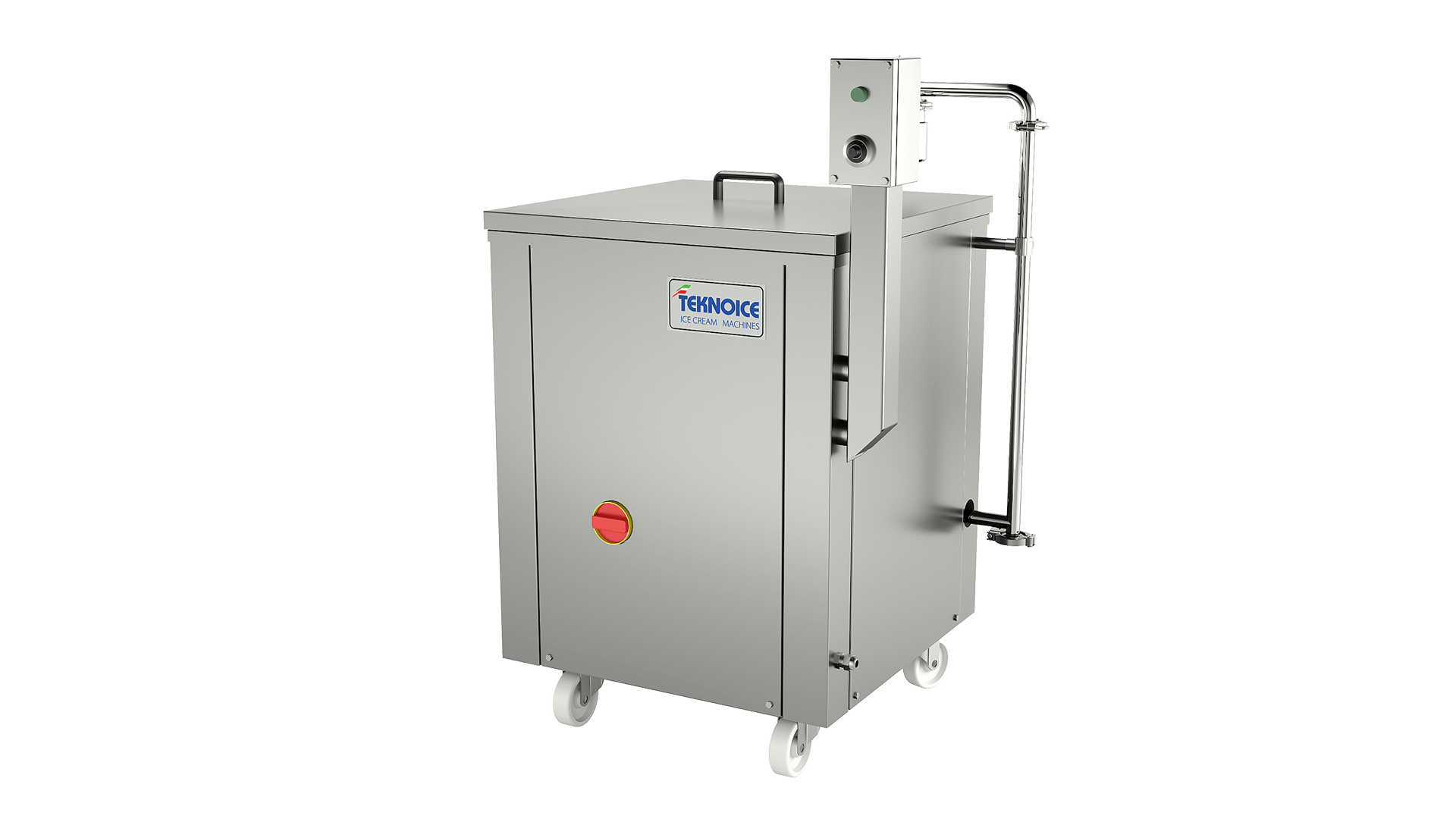
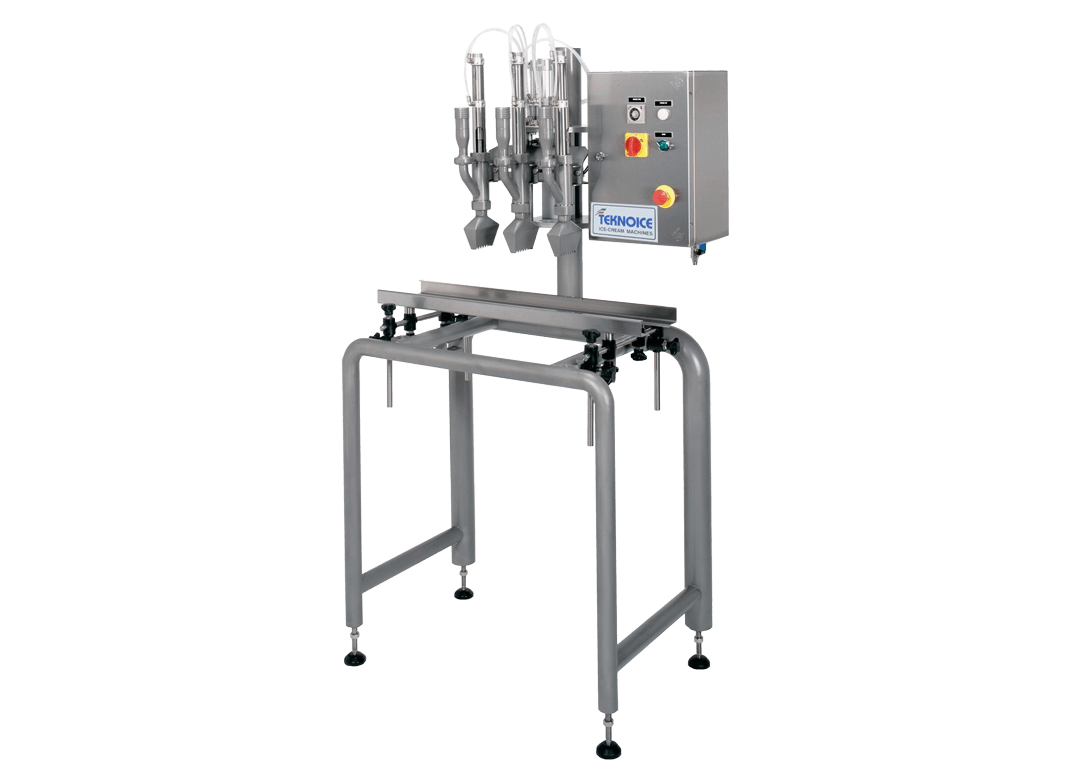
Le fruit feeder for inclusions Suitable for chocolate chips, fruit, and pieces compatible with the recipe. marbling pump form of visible ribbons, without completely homogenizing the grout.
The choice of ice dosing and filling solution It depends on the number of formats, the production rate, container changes, and available space. The packaged ice must then be hardened at sub-zero temperatures under appropriate conditions and then stored in accordance with the food safety plan.
For what type of production?
A continuous line is designed for ice cream parlors and workshops whose orders justify a regular flow of ice cream or sorbet. It is particularly suitable for long runs, filling tubs or pots, and supplying multiple establishments.
For an Italian ice cream counter, the logic is different: the italian ice machine can produce directly for the service, without reproducing the six links of an industrial line of packaged ice cream.

To complete your equipment selection, explore our catalog of ice cream equipment and our guide to to make artisanal ice creamOrganizations in the sector, such as the National Confederation of French Glaciers, also shed light on the professions, while the Ministry of Ecological Transition publishes general information on energy and environmental issues.
Other methods of working ice
Methods vary depending on sales volumes and channels. Find out more about our ice universe.
F.A.Q
What is the difference between batch and continuous production?
Batch processing involves handling successive batches in a turbine. Continuous processing feeds a freezer with a steady flow for extended production. The choice depends on the number of flavors, volumes, and packaging method.
What is the flow rate in liters per hour for a continuous line?
The TeknoFreeze freezers offered cover nominal capacities from 150 to 1,600 L/h depending on the model. The throughput of the complete line also depends on preparation, overrun, dosing, cleaning, and shutdowns.
Is it possible to produce Italian ice cream continuously?
Yes, an Italian ice cream machine operates on a continuous production principle for service. However, its circuitry and use differ from those of an ice cream line that packages ice cream in tubs or cases.
Do I need a full line or just a freezer?
A freezer alone does not replace the sanitary preparation of the mix, nor maturation, nor packaging and sub-zero temperatures. However, a partial installation can complement existing equipment if the capacities and connections are compatible.
How much space and what electrical power is needed for a line?
There is no universal value. You have to add up the dimensions of the modules, the maintenance clearances, the circulation and storage, then note the power and utility specifications of each model on the technical data sheets before drawing up the plan.
Sizing your production line
Are you considering a continuous ice cream line? Tell us about your volumes, recipes, packaging formats, and space constraints. We can then analyze the equipment layout and expected throughput.
Request a line study